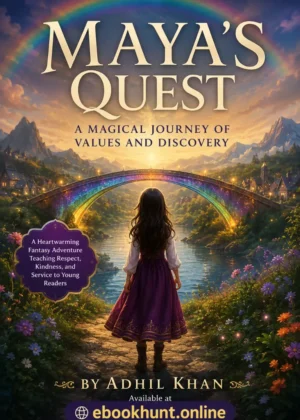
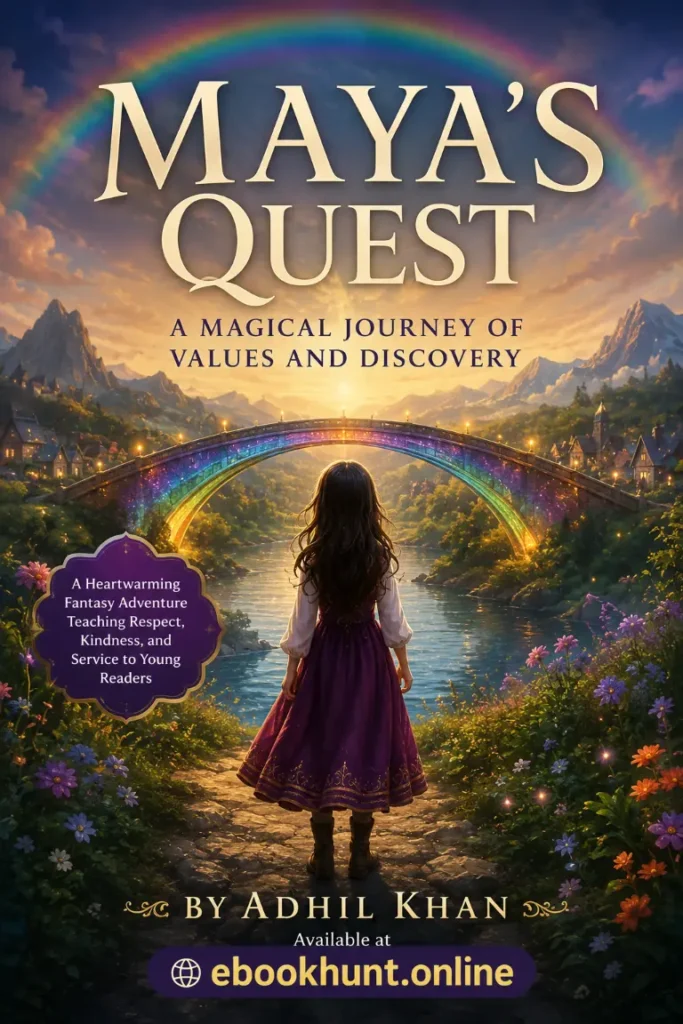
Maya’s Quest book review readers usually ask one thing first: does a book built around a moral lesson actually hold a child’s attention, or does it read like homework with a plot stapled on. P Adhil Khan’s Maya’s Quest: A Magical Journey of Values and Discovery is built around a shimmering Rainbow Bridge, a village ceremony, and one girl’s promise to live by respect, equality, and service. It’s free to read on ebookhunt.online, and the short answer is that it works because the values show up as scenes a child has to think through, not as a list read at them.
What is Maya’s Quest actually about?
Maya lives in a mountain village with a Rainbow Bridge at its center, said to be a gift from the Great Spirit of Harmony (the book’s name for the source of the village’s guiding values). Every spring, children stand at the bridge and make a promise. Maya’s turn arrives in the opening chapters, and she vows to respect her elders, treat everyone as equal, and serve people in need.
The promise isn’t the end of the story. It’s the setup. From there, Maya has to figure out what respect and service look like on an ordinary afternoon, not just at a ceremony with the whole village watching.
Why does the book’s structure work for young readers?
Each of the three core lessons, respect for elders, treating people as equals, and serving others, gets its own arc instead of a single chapter that names the value and moves on. A Wise Old Owl in an oak tree by the river tells Maya that his own younger self doubted the bridge and watched its light dim before he understood what the values meant in practice. That’s an unusual choice for a children’s book: the wise character admits he got it wrong first.
The clearest test comes when Maya finds two children arguing over a broken family heirloom. One is furious, the other is close to tears insisting it was an accident. Maya doesn’t hand down a verdict. She asks the angry child whether holding onto the anger is really what his grandmother would want, and asks the other to apologize and make it right. It’s a small scene, maybe 200 words, and it does more to explain what “respect” means day to day than a page of definitions would.

What makes this different from a typical values-based children’s story?
Most books built to teach a lesson pick one virtue and repeat it. Maya’s Quest sequences three: respect for parents and elders, equality across differences, and service to the community, treating each as a separate stage of the same walk across the bridge. The book also gives its adult and elder characters real interiority instead of leaving them as background wisdom-dispensers. Grandmother Tala, who leads the promise ceremony, tells the children she once faltered in keeping her own promise as a girl, and that making amends taught her more than getting it right the first time would have.
That detail matters for how the book reads out loud. A parent explaining respect to a 7-year-old benefits from a character who struggled with it too, not just one who already has it figured out.
The book leans into a specific comparison worth naming directly: it sits closer to a fable collection with a through-line character than to a single-arc adventure story. Readers looking for constant external stakes, a villain, a race against time, won’t find that here. Readers looking for a guide their child can actually apply this week will.
How does the story use its central symbol?
The Rainbow Bridge is described as reacting to Maya’s choices: its colors dim when she doubts herself and brighten after she acts with kindness. It’s a visual, physical stand-in for conscience, which is a genuinely useful device for a young reader who can’t yet name that concept in the abstract.
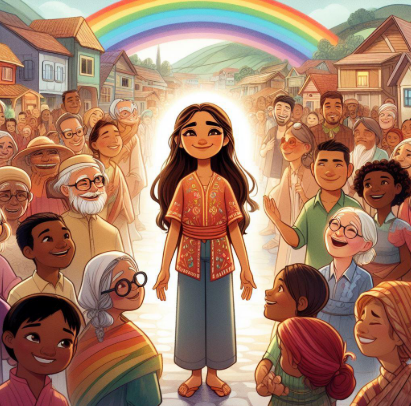
Later chapters introduce a celestial Guardian tied to the bridge who tells Maya her own actions are why she was chosen to learn its deeper purpose. Without spoiling where that thread goes, it’s worth saying the book ends on “To Be Continued,” so treat this as the opening chapter of a longer arc rather than a fully closed story.
Who is this book actually for?
Three groups, honestly:
- Parents reading aloud with children roughly ages 6 to 11, who want a story with built-in discussion points rather than a moral tacked onto the last page.
- Educators looking for a values or SEL (social-emotional learning, the classroom term for teaching kids to manage feelings and get along with others) text that already comes with reflection questions and activities baked into each part.
- Kids who like fantasy elements, a magical bridge, a Guardian, a village with its own traditions, but haven’t found a fantasy book that also respects their intelligence about real relationships.
If a family’s last few books were pure adventure with no room to pause and talk, this is a natural next pick. If a child wants nonstop external conflict on every page, it may feel slower than expected in the early chapters.
What’s the actual reading experience like on ebookhunt.online?
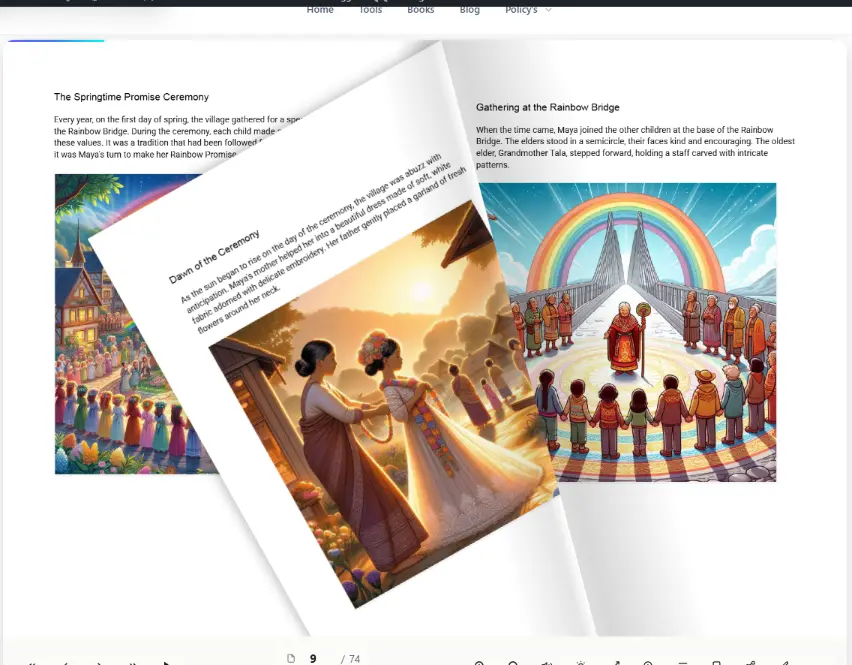
Maya’s Quest reads well as a bedtime or wind-down book, which is where ebookhunt.online’s ambient sound options actually earn their place instead of feeling bolted on. The soft piano or rain background pairs naturally with the bridge’s quieter, reflective scenes, and dark mode with adjustable text zoom makes it easier for a parent and child to read side by side without straining. The page-turn animation and sound effect give the book a printed-page feel, which matters for a story this clearly built around ceremony and tradition.
Free ebooks for kids on ebookhunt.online A links to the site’s children’s and family reading category
Is Maya’s Quest worth reading if your family already has a values-based book?
That’s the real question behind most of this Maya’s Quest book review, and it depends on whether the last one felt like a lecture. Maya’s Quest earns its lessons through scenes a child has to sit with, the vase argument, Grandmother Tala’s confession, the owl’s own doubt, rather than through a narrator stating the moral outright. That structural choice is the book’s real strength, and it’s also the reason it reads slower than a straight adventure. For a family looking for a story to actually discuss at the dinner table, that trade-off is the point.
how storytelling supports social-emotional learning in children A links to a peer-reviewed source or major education-research organization on SEL and narrative
FAQ
Is Maya’s Quest free to read online?
Yes. Maya’s Quest: A Magical Journey of Values and Discovery is available to read free on ebookhunt.online, with the site’s page-turning reader and ambient sound options built in.
What age group is Maya’s Quest written for?
It’s aimed at children roughly 6 to 11, and works well as a read-aloud for younger kids or an independent read for confident readers in that range.
What values does Maya’s Quest teach?
The book centers on three values in sequence: respect for parents and elders, treating people equally regardless of background, and serving others through everyday kindness.
Is Maya’s Quest a complete story or part of a series?
The book ends on a “To Be Continued” note after introducing a Guardian tied to the Rainbow Bridge, signaling more of Maya’s story is planned rather than a fully closed single-book arc.
Who wrote Maya’s Quest?
P Adhil Khan, who also wrote the science fiction novel The Horizon’s Final Stand, and runs FamilyStoriesTo.online alongside ebookhunt.online.
Does Maya’s Quest include discussion questions for parents or teachers?
Yes. Each part ends with reflection questions and a short activity, such as drawing a personal version of the Rainbow Bridge or keeping a week-long kindness journal.
How is Maya’s Quest different from other children’s fantasy books?
Most fantasy books for this age group build tension around an external threat. Maya’s Quest builds its tension around a child working out how to act, using a magical bridge as a visual stand-in for conscience rather than a battle to win.