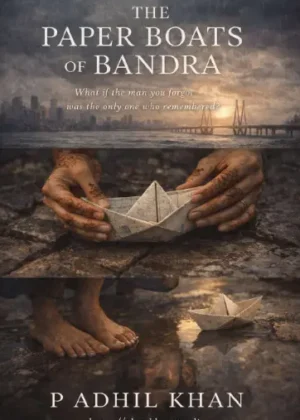
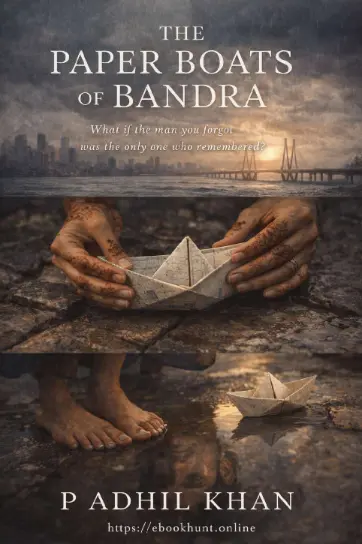
The Paper Boats of Bandra is a free romantic thriller by P Adhil Khan about Aria Mehta, a museum art restorer who loses six months of memory in a car accident, then finds a dying stranger’s voice note that unravels everything her mind erased. The story runs on one real, checkable detail: 23 paper boats, hidden inside the seawall at Bandra Bandstand in Mumbai, each one holding a piece of a truth Aria was never allowed to keep.
Read it free on ebookhunt.online, with the 3D page-flip reading experience built for exactly this kind of slow-burn, secret-heavy story.
What is The Paper Boats of Bandra about?
The Paper Boats of Bandra opens on Aria Mehta, mid-resignation letter, when she finds a manila envelope hidden behind a loose tile in her staff locker. Inside is a cracked phone with one audio file: a two-minute voice note from a man dying of a brain illness he never told her about, a man whose name she has never heard.
Her body remembers him even though her mind does not. That single contradiction drives the rest of the book: a search across Mumbai’s monsoon season for 23 paper boats this man built and hid before he disappeared, each one carrying a fragment of a relationship Aria’s amnesia erased.
Who is Aria Mehta, and what does the voice note change?
Aria restores paintings for a living, which is its own quiet irony: she spends her days repairing other people’s damaged history while unable to face her own. She has retrograde amnesia (memory loss that wipes out events from before an injury, not after it), erasing April through September of the year she was in a car accident.
The voice note belongs to Viraat Shetty, an architect she is told she never officially knew. Her sister Meera, a doctor who treats every hard conversation like a diagnosis, reveals he was in the car with her the night of the crash and vanished from her life the moment she woke up, believing silence was kinder than a memory rebuilt in pieces.
She had already been drafting a resignation letter before any of this started, unrelated to Viraat as far as she knows, which tells you how unsteady her life already was before a dead man’s voice reopened it. The book spends its first act on the gap between what her family’s version of events says and what her body still carries, right down to a name she should not know arriving on her tongue without warning.
Why do the paper boats and the silver rings matter so much?
Every boat Aria finds holds a specific, small fact: a taste she disliked, a scar, the exact fish market where they first kissed. That specificity is what makes this novel feel earned rather than sentimental. By the twelfth boat, hidden highest in the wall and wrapped in waxed canvas instead of paper, she finds something that isn’t a note at all: a silver toe ring, oxidized, an exact twin to the one her grandmother has worn alone for decades.
Her grandmother lost the matching ring in a river during the 1947 Partition, a detail passed down as family folklore, not fact. Viraat somehow knew it anyway, which turns the boats from a love story prop into a genuine mystery about how much of Aria’s erased life he actually shared. Readers curious about the real history behind that kind of family object, the jewellery, letters, and keepsakes carried across the new border in 1947, can see original artifacts and testimonies at the Partition Museum, the world’s first museum built around that migration.

(add image here: paper boats folded from old letters, resting against the stone seawall at Bandra Bandstand) alt text: “paper boats hidden in a Mumbai seawall, the story’s central mystery object”
Where does the Partition history come in?
The Partition thread is not decoration. Aria’s grandmother’s story about Lahore, the land her family lost, and the ring she kept waiting for its pair to return runs underneath the main mystery for the full 25 chapters. Viraat, it turns out, spent months building cedarwood architectural models and writing in the margins of his blueprints, and somewhere in that habit he learned family history Aria herself was never told outright.
By the middle of the book, his architecture work and her museum work start pulling toward the same object: a piece of property and inheritance dispute tied to Partition-era Lahore that neither of them fully understands yet. The novel treats that inherited grief with the same weight it gives the romance, which is part of what separates it from a straightforward amnesia love story.
Is The Paper Boats of Bandra free to read?
Yes. The Paper Boats of Bandra is free to read on ebookhunt.online, with the platform’s realistic 3D page-turn animation, ambient monsoon and ocean soundscapes, and dark mode built for a story that spends most of its pages in rain. Given how much of the book turns on Aria physically wading through tide water to find each boat, the ambient sound mode is one of the more fitting pairings on the site right now.
Who should read The Paper Boats of Bandra?
The Paper Boats of Bandra is for readers who want their romance to come with real stakes attached: a terminal diagnosis, a family secret decades old, and a mystery that unfolds through physical objects rather than flashbacks alone. It suits anyone who enjoyed a slow reveal built on hidden letters or objects, and readers specifically drawn to memory loss as a love story device will find it sits comfortably next to ebookhunt.online’s wider look at why memory loss love stories keep finding new readers.
It is not the right pick for someone who wants a light, low-stakes read. The book sits inside grief, illness, and inherited trauma on purpose, and says so plainly in its own author’s note.
Compared to the usual second-chance romance, where the obstacle is a fight or a misunderstanding, this one puts the obstacle inside Aria’s own head. She isn’t choosing whether to forgive Viraat. She is trying to find out what there even is to forgive, one boat at a time, while her sister and her own doctors keep telling her the man in the voice note should not exist. That structural choice, a mystery a reader solves alongside a protagonist who cannot fully trust her own memory, is the clearest reason this holds attention past the first chapter.
FAQ
Is The Paper Boats of Bandra a true story?
No. The Paper Boats of Bandra is a work of fiction by P Adhil Khan. The author’s note states plainly that the characters, the Partition backstory, and the events are invented, though the novel draws on real historical themes like Partition-era migration and memory loss for emotional accuracy.
How many paper boats are hidden in The Paper Boats of Bandra?
Twenty-three. Viraat hides one paper boat for every week he and Aria were together before he disappeared, plus one final boat made of waterproof canvas instead of paper, which holds the object that changes the whole story.
What genre is The Paper Boats of Bandra?
It is a romantic thriller with a mystery structure, built around amnesia, a terminal illness, and a decades-old Partition secret. The copyright page describes it plainly as a romantic thriller of lost memories, silver rings, and 23 paper boats.
Who wrote The Paper Boats of Bandra?
P Adhil Khan wrote it, publishing the book in February 2026 through Amazon Kindle Direct Publishing and on ebookhunt.online, where it is available to read free.
Does The Paper Boats of Bandra have a happy ending?
The book resolves Aria’s search for what happened to Viraat and to her missing six months, but whether that resolution reads as happy depends on what a reader considers a fair trade for the truth. The story earns its ending rather than announcing it early, so it is worth reaching without a spoiler in hand.
What illness does Viraat have in The Paper Boats of Bandra?
The book keeps the exact diagnosis deliberately vague for most of its length. What is clear early on is that it affects his memory the way Aria’s accident affects hers, a mirror the story leans on rather than explains upfront.
How long is The Paper Boats of Bandra?
It runs 25 chapters, set mostly in and around Bandra, Mumbai, with its Partition-era backstory reaching back to Lahore before 1947.