

Free ebook sites range from massive public-domain archives to small volunteer projects, and the gap between the good ones and the broken ones is bigger than most lists admit. This piece covers six free ebook sites that actually work in 2026, what each one is genuinely best for, and how to tell a safe site from one that buries you in pop-ups or hands you a corrupted file. The short answer: Project Gutenberg and Standard Ebooks are the two to try first for classics, ManyBooks and Open Library cover newer and borrowable titles, and ebookhunt.online is worth a look if the reading experience itself matters as much as the book does.
What makes free ebook sites worth trusting in 2026?
Trustworthy free ebook sites tell you plainly where their books come from, don’t force a download before you’ve read a page, and don’t need constant sign-ups just to browse. Most legitimate free ebook sites fall into three categories: public-domain libraries (books whose copyright has expired, so anyone can share them for free), lending platforms that hold a formal licensing arrangement with publishers, and sites that host independently published or author-approved free titles.
The warning signs stay consistent across bad ones: a download button that doesn’t match the file it produces, a flood of unrelated pop-up ads, or a request for payment details on something advertised as free. A genuinely useful site earns your visit back, not just your first click. Catalog size matters less than most rankings suggest, too. A site with 5,000 well organized, correctly tagged titles is more useful in practice than one claiming a million records that turn out to be duplicate scans or broken links once you actually search for a specific book.
Speed is worth checking as well. A page that takes eight seconds to load a single chapter usually means the host is running ad networks stacked three or four layers deep, and that’s often the same site that buries the real download link under two fake ones.
Mobile behavior is another quiet signal. Well-built free ebook sites resize cleanly on a phone screen without a text column running off the edge or a menu that only works with a mouse. Most of the free ebook sites people keep coming back to were built with a phone in mind first, not as an afterthought bolted onto a desktop layout years later.

Project Gutenberg: the deepest public domain library online
Project Gutenberg is the oldest site on this list, started in 1971 by Michael Hart, and it now holds more than 70,000 titles. Nearly everything on it is public domain, so there’s no sign-up, no trial period, and no catch: you pick a book and read or download it.
The catalog leans heavily toward classic literature, philosophy, and older reference works, which makes it the strongest pick for anyone chasing Austen, Dickens, or Shakespeare rather than a 2025 release. Formats include plain text, EPUB, and Kindle-ready files, and the site itself loads fast because it skips the heavy design most modern free ebook sites carry.
Project Gutenberg to the official Project Gutenberg library at gutenberg.org
Searching by author or title works well once you know what you’re after, and the catalog is browsable by bookshelf category (adventure, history, children’s literature) for anyone who wants to explore without a specific title in mind. There’s no ad network running underneath any of it, which is part of why the page loads instantly even on a slow connection. Plenty of free ebook sites bury a catalog this size behind layers of pop-ups; Gutenberg’s plain, text-first design is part of why it’s stayed the default recommendation for decades.
Open Library: borrow newer titles instead of only public domain ones
Open Library, an Internet Archive project, works differently from a download-only archive. It gives access to more than 20 million book records, and many of the newer or still-copyrighted titles are available to borrow rather than keep, the same way a physical library lends a book for a set period.
This borrowing model is what separates Open Library from most other free ebook sites: it’s the option to try when the book you want was published in the last few decades, not the last few centuries. Borrowed titles open in Open Library’s own reader, and returns happen automatically when the loan period ends, so there’s nothing to remember to give back.
Open Library the official Open Library catalog at openlibrary.org
There’s a waitlist system for popular titles, the same way a physical branch might have three copies and a queue of twelve people. It’s a fair trade-off: the catalog includes far more recent releases than a pure public-domain archive ever could, at the cost of occasionally waiting a week or two for a specific title to free up.
Standard Ebooks: perfectly formatted public domain classics
Standard Ebooks takes the same public-domain source material Project Gutenberg works from and rebuilds each title by hand: fixed typos, real semantic formatting, consistent typography, and covers that don’t look like a photocopy. It’s a volunteer-run project with a much smaller catalog than Gutenberg’s, but every title on it has been proofread and formatted the way a modern reader expects.
If a scanned-and-uploaded classic with broken paragraph breaks has ever ruined a read, Standard Ebooks solves that specific problem. Most free ebook sites treat a scanned public-domain text as good enough once it’s readable; Standard Ebooks treats it as a starting point. It’s a niche pick among the free ebook sites on this list, but it’s the right one when formatting quality matters more than sheer catalog size. The project even publishes its production process openly, so anyone curious about how a 120-year-old scanned text turns into a clean modern EPUB can see the actual steps involved.

Standard Ebooks the official Standard Ebooks library at standardebooks.org
ManyBooks: the most format choices for genre fiction
ManyBooks holds a catalog of more than 50,000 free titles across genres, including romance, mystery, science fiction, and historical fiction, and it supports more output formats than most competing free ebook sites: PDF, EPUB, MOBI, and a few others depending on the title. A free account gives you downloads and a few extras, including genre alerts and a reader discussion section.
The trade-off is quality control. Because ManyBooks pulls from independent and self-published authors as well as public domain sources, formatting and editing vary title to title. Spend a minute reading the sample pages before committing to a download, since a strong cover doesn’t always mean strong editing underneath it. It’s still one of the more useful free ebook sites for genre fiction specifically, and pairs well with a genre hub like best free novel sites for anyone building a reading list around one specific genre. Few other free ebook sites bother building genre-alert tools like this, which is what keeps regular readers coming back instead of downloading once and moving on.
LibriVox: audiobooks instead of downloads
LibriVox is a volunteer project that records free public-domain audiobooks, chapter by chapter, read by ordinary people rather than professional narrators. Quality varies by reader, since one chapter might be read by a calm, practiced volunteer and the next by someone reading into a laptop mic for the first time, but the entire catalog costs nothing and needs no account.
It belongs on this list because plenty of readers use it alongside a text version, unlike most other free ebook sites that only ever offer one format: listening on a commute, then picking up the same title in EPUB form to finish a chapter at a desk. For public-domain classics specifically, that combination costs nothing at all, and it’s one of the few ways to experience a 19th-century novel the way it would have sounded read aloud in its own time.
LibriVox the official LibriVox audiobook catalog at librivox.org
ebookhunt.online: built around the reading experience, not just the file
Every site above focuses on getting a book file onto your device. What happens after that download finishes is where most readers actually lose interest, and it’s the specific problem ebookhunt.online is built around. It’s the one entry on this list of free ebook sites built primarily as a reading experience rather than a download source.
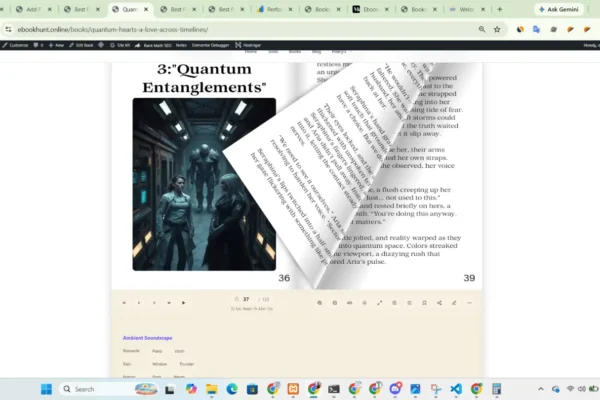
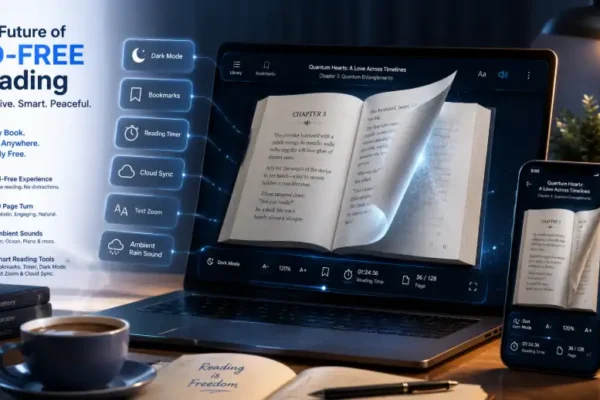
Books open in a reader with a realistic 3D page-turning animation and sound, rather than a flat scroll or a bare PDF viewer. Dark mode and adjustable text zoom handle late-night reading and smaller screens, and ambient background audio (ocean, rain, piano, violin, thunderstorm) runs quietly behind the page if silence isn’t what helps you focus. A built-in reading-time tracker and bookmarking mean picking a book back up doesn’t mean hunting for the page you left off on.
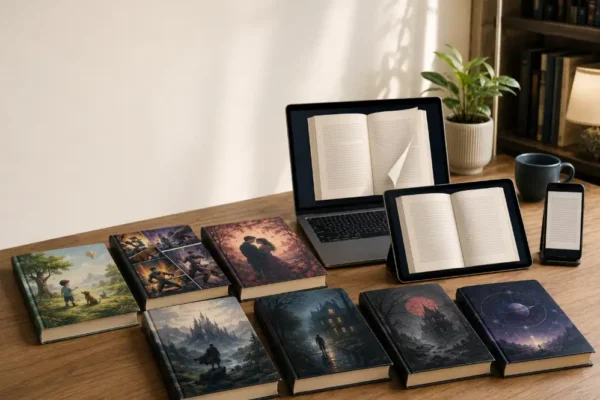
The catalog spans children’s stories, comics, romance, fantasy, thriller, and horror, alongside the reading tools most other free ebook sites don’t bother building. Anyone who wants the fuller picture of what’s on offer can (add inner link here: read ebooks online free for a closer look at the reader itself.

What do EPUB, PDF, and MOBI actually mean for ebook downloads?
EPUB is the format built for reading, since the text reflows to fit whatever screen it’s opened on, phone or tablet or laptop alike. PDF locks the page layout in place, which is exactly right for a textbook with diagrams but often forces awkward zooming and side-scrolling on a smaller screen. MOBI is an older Kindle-specific format that most modern free ebook sites are phasing out in favor of EPUB and Amazon’s newer KFX format.
One term worth knowing before it causes confusion: DRM (digital rights management, the copy-protection some publishers attach to a file to stop it being freely shared). Public-domain titles from free ebook sites like Project Gutenberg or Standard Ebooks never carry DRM, since there’s nothing left to protect. A borrowed title from Open Library does carry DRM, because the book is still under copyright and the license is temporary by design. Knowing which format a site offers before clicking download saves a wasted file that won’t open on whatever app or reader is already set up on your device.
Is it legal to use free ebook sites?
It depends entirely on where the book came from, not on whether the free ebook site charges money. Public domain books, meaning the copyright has expired, are legal for anyone to read, copy, or redistribute for free. In the United States, that generally covers work published before 1930, plus anything the original author or publisher has deliberately released for free.
Copyrighted books are a different situation. Downloading a still-protected title without the rights holder’s permission is copyright infringement, regardless of whether the free ebook site hosting it charges a fee. Legitimate free ebook sites will say clearly whether a title is public domain, independently published with the author’s consent, or available through a licensed lending arrangement like Open Library’s. If a site doesn’t say, that’s usually the answer.
U.S. Copyright Office public domain guidance The official copyright.gov overview of public domain terms
There’s a middle category worth knowing about too: Creative Commons licensed work, where the author keeps copyright but explicitly permits free sharing under specific terms (some allow commercial use, others don’t; some require attribution, others don’t). A site that hosts Creative Commons titles alongside public domain ones should label each book with its actual license, not lump everything under one vague “free” tag.
Public domain rules also vary by country, since copyright term length isn’t the same everywhere. A book that’s public domain in the United States can still be under copyright in Canada, the UK, or India, depending on when the author died and how long that country’s copyright term runs. This is one reason honest free ebook sites label each title’s copyright status clearly instead of leaving readers to guess. Readers outside the US using a US-based free ebook site are generally covered by where the site itself operates, but it’s worth a quick check for anything published within the last century before assuming it’s automatically clear.
How do you tell if an ebook download is actually safe?
Check the file type before you click. A site offering EPUB, PDF, or MOBI downloads is behaving normally; one that wraps a book download in an executable (.exe) file is not, and that file should never be opened, regardless of how convincing the book cover on the download page looks.
A few more checks worth running every time on new free ebook sites:
- Look for a working About or Contact page. Sites with no identifiable owner are harder to trust and harder to report if something goes wrong.
- Scan reviews or forum mentions before your first download, not after.
- Check whether the download count and file size look proportional to the book (a 400-page novel shouldn’t be a 2 GB file).
- Avoid free ebook sites that require a browser extension install just to enable a download button.
- Open a new, unfamiliar site in a private or incognito window the first time, so any tracking cookie it sets doesn’t follow your regular browsing.
- If a “download” link opens five new tabs before the file starts, close all of it and try a different source. Legitimate free ebook sites never need five redirects to hand over a file they’re supposedly offering for free.

Free ebook sites compared: which one fits what you actually want?

| Free ebook site | Best for | Format | Sign-up needed |
|---|---|---|---|
| Project Gutenberg | Largest public domain catalog | TXT, EPUB, Kindle | No |
| Open Library | Newer, still-copyrighted titles | Borrow in-browser | Free account |
| Standard Ebooks | Cleanly formatted classics | EPUB, Kindle | No |
| ManyBooks | Genre fiction, format variety | PDF, EPUB, MOBI | Free account |
| LibriVox | Public domain audiobooks | MP3, OGG | No |
| ebookhunt.online | Page-flip reading experience | In-browser reader | No |
None of these free ebook sites is the single right answer for every reader. Someone chasing a specific out-of-print classic wants Gutenberg or Standard Ebooks first. Someone who wants the book to actually feel like reading, complete with sound and page motion, gets more out of browse free ebooks by genre than out of a bare download link. Students working through assigned reading tend to land on Open Library for newer editions, while anyone building a long-term personal library still leans on Gutenberg and Standard Ebooks for the depth of the catalog alone.
FAQ
Are free ebook sites legal to use?
Yes, when the books are public domain or the author has released them for free. Free ebook sites become a legal problem only when they host still-copyrighted work without the rights holder’s permission, so check what a site says about where its titles come from before downloading.
What is the best site for classic literature?
Project Gutenberg has the largest public domain catalog, and Standard Ebooks offers the same era of books reformatted for cleaner reading. Between the two, Gutenberg wins on sheer size and Standard Ebooks wins on formatting quality. Neither charges anything or asks for an account.
Can I read online without downloading anything?
Yes. Open Library lets you borrow and read in-browser, and ebookhunt.online’s page-flip reader opens books directly in the browser with no file ever touching your device. This suits anyone reading on a work or school computer where installing new software isn’t an option.
Do free ebook sites work on mobile phones?
Most do, since EPUB and browser-based readers are built to resize for smaller screens. A page-flip reader like the one on ebookhunt.online, dark mode, and adjustable text zoom specifically help on a phone screen where a flat PDF often runs too small to read comfortably.
Why do some free ebook sites ask for a free account?
Sites like Open Library and ManyBooks use accounts to manage lending limits or open up extra formats, not to charge money. Any site asking for payment details on something advertised as free is a separate situation worth avoiding entirely, no matter how it’s dressed up.
Are free ebook downloads safe from viruses?
The reputable free ebook sites are, provided downloads stay in standard formats like EPUB, PDF, or MOBI. Any site that pushes an executable file or a browser extension before you can download a book should be treated as a risk, not a shortcut worth taking.
What’s the difference between a free ebook site and a free ebook library?
In practice, not much. Both terms usually mean the same thing: a collection of books available at no cost, either to download or to borrow. The real difference worth checking is whether the site owns or licenses its catalog outright (Project Gutenberg, Standard Ebooks) or lends copyrighted titles under a formal arrangement (Open Library).
Do I need a Kindle or special device to use free ebook sites?
No. Most free ebook sites work fine in a regular browser or a free reading app on a phone, tablet, or laptop. A Kindle only matters if a site’s only download format is MOBI or the newer Amazon-specific KFX, and even then, most EPUB files can be converted or opened through a different free reader instead.